
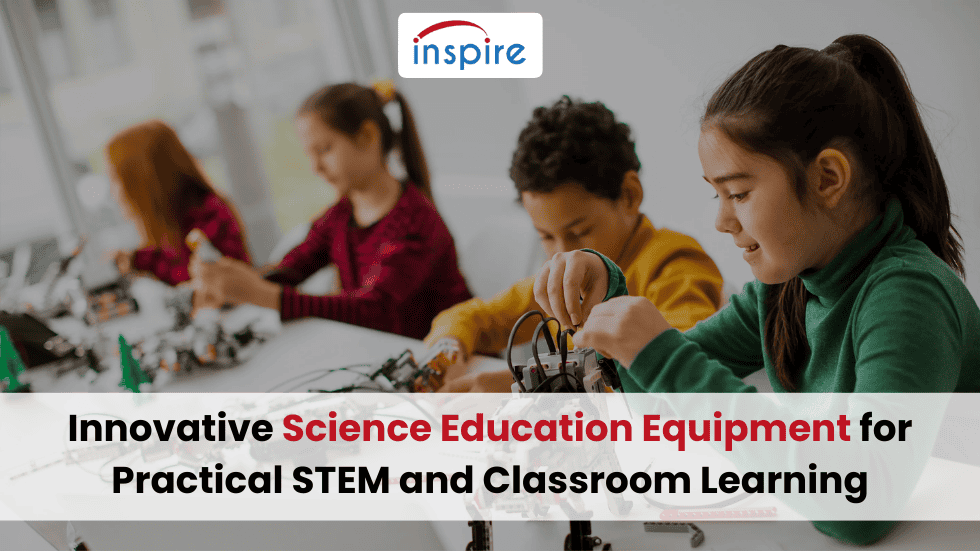
In the modern education system, STEM learning has become one of the most important foundations for preparing students for future careers. STEM stands for Science, Technology, Engineering, and Mathematics, and it focuses on developing analytical thinking, creativity, and problem-solving skills. While theoretical learning helps students understand basic concepts, practical learning allows them to apply those concepts in real-life situations. This is where Science Education Equipment plays a vital role in transforming classrooms and laboratories into interactive learning spaces.
Science Education Equipment helps students understand complex scientific theories through experimentation, observation, and analysis. It allows educators to demonstrate real-world applications of scientific principles, making learning more engaging and effective.
Importance of Science Education Equipment in STEM Learning
Traditional classroom learning often focuses heavily on textbooks and lectures. However, modern students require more interactive learning methods that encourage participation and curiosity. Science Education Equipment provides hands-on learning opportunities that help students develop deeper understanding of scientific concepts.
Practical experiments improve student engagement because they allow learners to see results directly. When students perform experiments themselves, they gain confidence and develop stronger analytical skills. Science Education Equipment also supports inquiry-based learning, where students explore scientific questions and discover answers through experimentation.
Another major advantage is that it helps bridge the gap between theory and real-world application. Students can understand how scientific laws and principles work in practical situations, which strengthens their overall learning experience.
Evolution of Science Education Equipment
Science laboratories have evolved significantly over the years. Earlier, laboratory equipment required complex wiring, manual calculations, and time-consuming experiment setups. Modern Science Education Equipment has simplified these processes by integrating digital technology, wireless connectivity, and automated data collection.
Today’s equipment allows students to record and analyze experimental data in real time. This reduces human error and helps students focus on understanding results rather than spending time on manual measurements. Advanced equipment also supports digital learning by integrating software applications and mobile devices, making experiments more efficient and accessible.
Key Features of Modern Science Education Equipment
Modern Science Education Equipment offers several features that improve the quality of classroom and laboratory learning.
Real-Time Data Monitoring
Modern laboratory tools provide instant measurement and graphical representation of experimental data. Students can observe how different variables affect experimental outcomes, which improves concept clarity.
Wireless and Digital Integration
Wireless technology allows experiments to be conducted without complicated wiring systems. Students can easily connect sensors and devices to computers or tablets, making experiments more flexible and convenient.
Modular and Flexible Design
Many Science Education Equipment systems are designed in modular formats. This allows educational institutions to select equipment based on curriculum requirements and expand their laboratories gradually.
Safety and Durability
Modern equipment is built using high-quality materials and follows safety standards to ensure secure learning environments. Durable equipment reduces maintenance costs and provides long-term usability.
Types of Science Education Equipment Used in Classrooms
Science Education Equipment includes a wide range of tools that support various scientific subjects. Some of the most commonly used categories include:
Mechanics Equipment
Mechanics equipment helps students study motion, force, and energy. Tools such as air tracks, motion sensors, and dynamics carts allow students to conduct experiments related to Newton’s laws and momentum. These tools help students understand how physical forces influence movement and energy transfer.
Optics Equipment
Optics equipment allows students to study light behavior, including reflection, refraction, and wave patterns. Laser kits, lenses, mirrors, and ripple tanks help students visualize optical phenomena clearly. These tools make it easier for students to understand complex concepts that are difficult to grasp through theoretical learning alone.
Electricity and Magnetism Equipment
Electricity kits help students understand circuit formation, electrical current, and electromagnetic principles. By building circuits and testing electrical components, students gain practical knowledge of electrical science and engineering fundamentals.
Measurement and Data Collection Tools
Modern laboratories use sensors and digital instruments to measure variables such as temperature, pressure, force, and motion. These tools improve experiment accuracy and help students learn data analysis techniques.
Benefits of Science Education Equipment in Classroom Learning
Enhances Student Engagement
Hands-on experiments make learning more interesting and interactive. Students are more likely to participate actively when they can perform experiments themselves.
Improves Concept Understanding
Science Education Equipment allows students to visualize theoretical concepts through real experiments. This improves knowledge retention and reduces confusion.
Develops Critical Thinking and Problem-Solving Skills
Practical learning encourages students to analyze results, identify errors, and design solutions. These skills are essential for academic and professional success.
Encourages Teamwork and Collaboration
Laboratory experiments often require students to work in groups. This improves communication skills and promotes collaborative learning.
Prepares Students for Future Careers
Science Education Equipment helps students develop technical and analytical skills required in STEM careers such as engineering, research, healthcare, and technology.
Role of Science Education Equipment in Smart Classrooms
Smart classrooms combine digital technology with practical laboratory learning. Modern Science Education Equipment supports this integration by providing software-based experiment monitoring, mobile compatibility, and remote learning support.
Digital laboratories allow teachers to demonstrate experiments using virtual simulations alongside physical equipment. This blended learning approach improves accessibility and helps students understand complex scientific processes more effectively.
Supporting Teachers Through Advanced Equipment
Science Education Equipment also benefits educators by simplifying experiment setup and classroom management. Modern tools often include instructional manuals, experiment guidelines, and training resources that help teachers deliver effective lessons.
User-friendly equipment reduces preparation time and allows teachers to focus on explaining scientific concepts and guiding students during experiments. Technical support and training programs further help educators maximize the use of laboratory tools.
Future Trends in Science Education Equipment
The future of Science Education Equipment is closely connected with technological innovation. Artificial intelligence is expected to play a major role in analyzing experimental data and providing personalized learning feedback. Virtual and augmented reality technologies will allow students to conduct simulated experiments and visualize microscopic or complex processes.
Portable STEM kits are also gaining popularity because they allow students to perform experiments outside traditional laboratories. These kits support remote learning and make science education more accessible to students in different locations.
Conclusion
Science Education Equipment has become an essential part of modern STEM education. It transforms classrooms into interactive learning environments where students can explore scientific concepts through experimentation and observation. By providing practical learning experiences, Science Education Equipment improves student engagement, strengthens conceptual understanding, and develops essential technical skills.
As educational institutions continue to adopt experiential learning methods, the demand for advanced Science Education Equipment will continue to grow. Schools and universities that invest in innovative laboratory tools can provide students with high-quality education and prepare them for future scientific and technological challenges. Through practical STEM learning, students gain the confidence, knowledge, and skills required to succeed in an increasingly technology-driven world.