
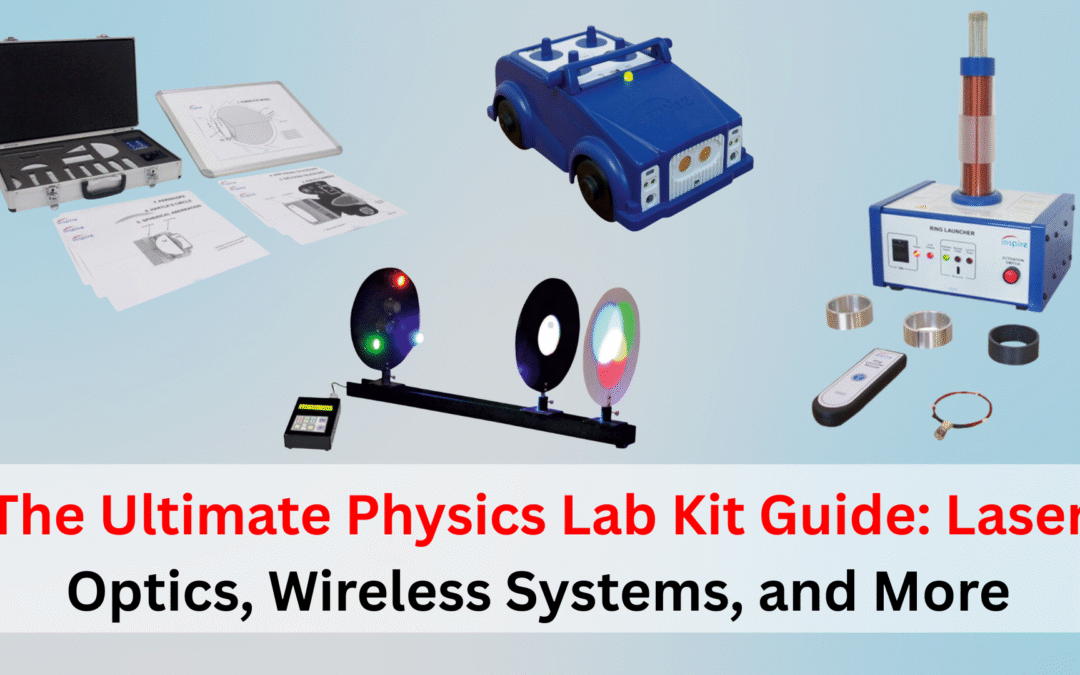
Physics is the cornerstone of modern science, shaping our understanding of the universe and how everything in it works—from the tiniest subatomic particles to the vastness of galaxies. In the educational journey of a budding scientist or engineer, hands-on learning is essential. This is where advanced physics lab tools come in. These tools empower educators to turn theory into practice, making abstract concepts easier to understand through visualization and experimentation.
Whether you’re upgrading a school lab or designing a new one, having the right equipment matters. In this comprehensive guide, we explore essential physics lab kits and tools—ranging from laser optics and linear air tracks to wireless sensors and ring launchers—ideal for schools, colleges, and institutions looking to provide quality STEM education.
Why Hands-On Physics Matters
Before diving into the list of tools, let’s establish the importance of physical experimentation in education. Physics is often perceived as one of the more abstract sciences due to its mathematical nature. However, when students see Newton’s laws in action or observe wave interference patterns firsthand, the learning becomes not just intuitive but unforgettable.
Using advanced physics lab tools helps bridge the gap between theoretical knowledge and practical understanding. These tools engage students, boost retention, and cultivate critical thinking.
Laser Optics: Bringing Light Theories to Life
One of the most captivating areas of physics is optics—the study of light. From reflection and refraction to interference and diffraction, optical experiments are central to any school curriculum.
Modern laser optics kits are a game-changer for demonstrating these principles. These kits typically include laser sources (often with different colors), beam splitters, optical lenses, mirrors, diffraction gratings, and mounts. They allow students to set up precise and safe experiments on:
- Ray tracing through lenses
- Measuring focal lengths
- Interference and diffraction patterns
- Optical bench configuration
The advantage of laser-based systems is the clarity of the beams. Unlike traditional light sources, laser beams are sharp and coherent, making it easier to observe and measure effects accurately. Schools looking for premium solutions can find high-quality laser optics kits at Inspire Physics, offering reliable and easy-to-use tools for optics education.
Linear Air Tracks: Precision in Motion Experiments
When it comes to studying motion, forces, and collisions, linear air tracks are one of the most effective tools available in the physics lab. These tracks reduce friction by suspending gliders on a cushion of air, allowing students to conduct precise and repeatable experiments on:
- Uniform motion
- Acceleration
- Newton’s second law
- Elastic and inelastic collisions
Some advanced physics lab tools include smart air tracks integrated with sensors, timers, or wireless light gates, giving real-time data and enabling students to visualize graphs of velocity, displacement, and acceleration almost instantly.
For educators aiming for an interactive and accurate experience, a linear air track system is indispensable.
Wireless Systems: The Future of Physics Labs
With the rise of digital learning, wireless tools are increasingly becoming a staple in modern physics labs. Wireless sensors, motion detectors, and intelligent light gates not only reduce setup time but also improve accuracy.
These systems are designed to interface with computers, tablets, or dedicated data loggers, offering students real-time feedback. Popular experiments that benefit from wireless tools include:
- Free-fall and acceleration due to gravity
- Kinematics and dynamics
- Pendulum motion and oscillations
These advanced physics lab tools support inquiry-based learning by giving students access to raw data and helping them derive conclusions based on evidence, just like real-world scientists.
Ring Launcher Apparatus: Demonstrating Electromagnetism
Electromagnetic induction is another critical topic in physics. The ring launcher apparatus is a dramatic and visual way to teach Lenz’s Law and Faraday’s Law of Induction. This tool works by sending a current through a coil, generating a magnetic field that launches a conductive ring into the air.
It’s a great demonstration piece and an exciting way to spark curiosity in students. The ring launcher is safe, easy to use, and provides a hands-on look at the principles behind transformers, induction cooktops, and magnetic levitation trains.
Compact Ripple Tanks: Making Waves Clear
Understanding the properties of waves—reflection, refraction, diffraction, and interference—is often more effective when visualized. Ripple tanks allow students to see wave phenomena using shallow water, a light source, and a screen.
Compact ripple tanks are part of the modern advanced physics lab tools arsenal and are often portable, easy to set up, and integrated with strobe lighting for high-contrast wave patterns. These tools help demonstrate concepts such as:
- Wave speed in different media
- Interference patterns from two sources
- Reflection and refraction angles
Essential Support Equipment: Power Supplies and Mounts
No lab kit is complete without reliable power sources and accessories. Whether powering electromagnets, running optics experiments, or charging sensors, a versatile physics power supply is a backbone of every lab setup.
The Inspire Power Supply, for instance, offers adjustable voltage levels and built-in safety features, making it ideal for schools. It can support a wide range of experiments, ensuring consistent and stable operation.
Similarly, optical benches, sensor stands, and rail systems play a critical role in maintaining the precision and integrity of experiments.
Designing a Well-Equipped Physics Lab
If you’re setting up a new physics lab or upgrading an existing one, it’s important to consider both curriculum alignment and ease of use. Start by identifying the core topics covered in your academic program and map them against the equipment needed.
Here’s a checklist of categories to include:
- Mechanics Tools: Linear air tracks, dynamics carts, pulleys
- Optics: Laser optics kits, lenses, diffraction gratings
- Electricity & Magnetism: Ring launchers, coils, multimeters
- Waves & Sound: Ripple tanks, tuning forks, resonance tubes
- Modern Physics: Photoelectric kits, radioactive models
Working with trusted providers like Inspire Physics ensures that your school receives durable, safe, and curriculum-ready equipment with proper technical support.
Conclusion: Empowering Education with Advanced Physics Lab Tools
Equipping schools with modern, reliable, and interactive lab tools is not just an investment in education—it’s an investment in the future. With the right advanced physics lab tools, students are more engaged, educators are better equipped, and institutions can offer hands-on STEM learning at the highest level.
From laser optics kits to intelligent wireless sensors and electromagnetic apparatus, today’s physics tools go far beyond traditional setups. Whether you’re a school administrator, a physics teacher, or an educational planner, choosing the right supplier and tools can elevate your curriculum and enhance student performance.
Explore the full range of innovative physics lab equipment at Inspire Physics and bring science to life in your classrooms.