
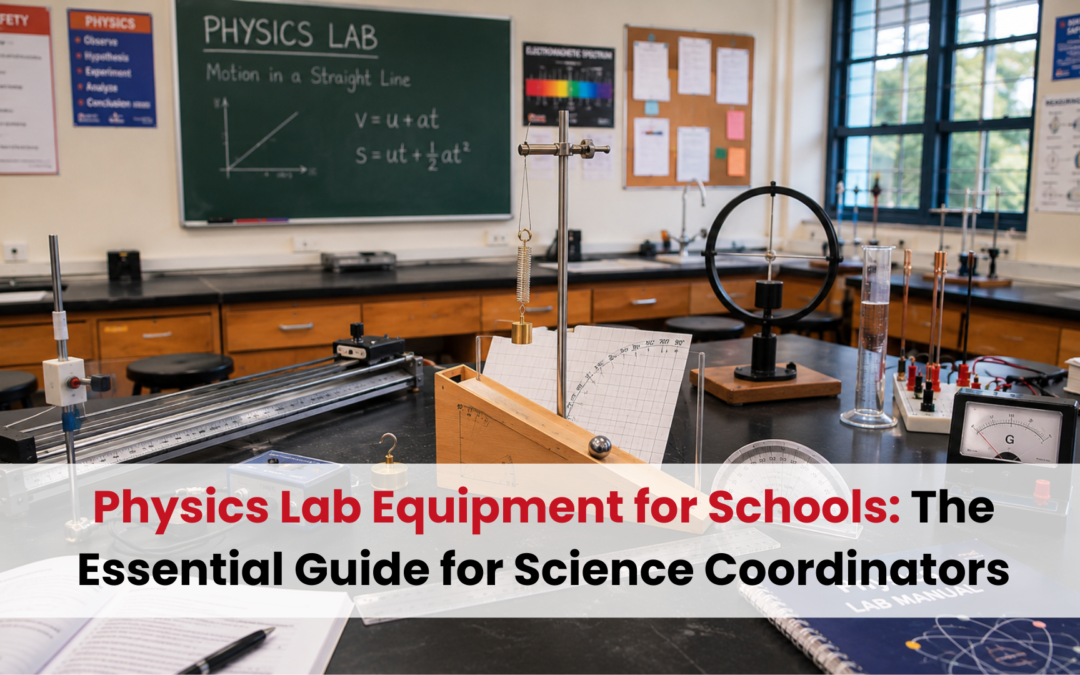
For any science coordinator, the physics laboratory is more than just a room filled with wires, weights, and glass; it is a sanctuary of discovery. It is the place where abstract mathematical equations transform into tangible realities. However, building and maintaining a functional laboratory requires strategic planning and a deep understanding of the core curriculum.
Providing high-quality Physics Lab Equipment For Schools is essential to fostering an environment where students don’t just learn physics—they do physics. This guide outlines the essential categories of equipment every science coordinator should prioritize to ensure a robust, safe, and inspiring learning environment.
The Foundation of Measurement: Precision Tools
Physics is the science of measurement. Before students can explore complex theories like electromagnetism or quantum mechanics, they must master the art of quantifying the physical world.
Every well-equipped lab needs a surplus of fundamental measuring instruments. This includes high-quality vernier calipers, micrometer screw gauges, and digital stopwatches. While traditional wooden meter rules are staples, integrating electronic sensors and data loggers allows students to capture real-time data with professional accuracy. These tools are the backbone of the lab, teaching students about significant figures, parallax errors, and the importance of precision.
Mechanics: Bringing Newton to Life
Mechanics is often the first major hurdle for physics students. To make concepts like acceleration, friction, and momentum relatable, hands-on kits are non-negotiable.
Key items include:
- Linear Air Tracks: These are vital for demonstrating Newton’s Laws of Motion and the conservation of momentum in a near-frictionless environment.
- Force Tables: Essential for teaching vector addition and static equilibrium.
- Pulley Systems and Pendulums: These allow students to calculate gravitational constants and understand the relationship between work and energy.
By using dedicated mechanics equipment, coordinators ensure that students move beyond “idealized” textbook problems and grapple with the variables of the real world.
Waves, Light, and Sound: The Optics Bench
The study of optics and wave phenomena provides some of the most “visual” moments in a physics education. To facilitate this, a school lab must have a reliable darkroom setup or blackout curtains, alongside versatile optics kits.
Science coordinators should invest in high-intensity laser pointers, ray boxes with multiple slits, and a variety of lenses (convex and concave) and prisms. Diffraction gratings and ripple tanks are also critical for demonstrating interference and diffraction patterns. When students can physically see a beam of light bend through a glass block or watch waves interact in a tank, their conceptual retention increases exponentially.
Electricity and Magnetism: Powering the Future
Electricity remains one of the most challenging topics for students because it involves invisible forces. High-quality Physics Lab Equipment For Schools bridges this gap by making the invisible visible.
Essential components include:
- Variable Power Supplies: Reliable DC and AC power sources are safer and more consistent than disposable batteries.
- Multimeters: Digital multimeters help students measure voltage, current, and resistance accurately.
- Van de Graaff Generators: These are excellent for demonstrating static electricity and high-voltage phenomena in a way that captures student interest.
- Circuit Boards: Modular breadboards or mounted circuit components allow for quick assembly and troubleshooting of series and parallel circuits.
Thermodynamics and Matter
Understanding heat transfer and the properties of matter requires specialized thermal equipment. Science coordinators should ensure the lab is stocked with copper calorimeters, immersion heaters, and digital thermometers. For more advanced levels, Boyle’s Law apparatus and thermal expansion kits are necessary to explore the relationship between pressure, volume, and temperature.
The Role of Technology: Data Logging
In the modern era, a physics lab is incomplete without digital integration. Data logging interfaces (like those from Vernier or Pasco) allow students to connect sensors for light, sound, motion, and temperature directly to their laptops or tablets. This technology enables them to graph results instantly, allowing more time for analysis and less time on manual plotting. For a science coordinator, investing in software-compatible hardware is a way to future-proof the laboratory.
Safety and Storage: The Coordinator’s Priority
Beyond the experimental kits, the “essential guide” must include safety. This involves high-quality safety goggles, heat-resistant mats, and organized storage cabinets. A cluttered lab is a dangerous lab. Using labeled bins and specialized trolleys for heavy equipment ensures that the Physics Lab Equipment For Schools remains in good condition for years, maximizing the school’s budget.
Conclusion
Selecting the right equipment is a balancing act between budget constraints and pedagogical needs. By focusing on high-durability, versatile tools that cover the core pillars of mechanics, optics, and electricity, science coordinators can create a world-class learning space.
At Inspire Physics, we believe that the right tools don’t just teach formulas—they ignite curiosity. Whether you are upgrading an existing facility or building a new lab from scratch, prioritizing quality equipment is the best investment you can make in the scientists of tomorrow.