

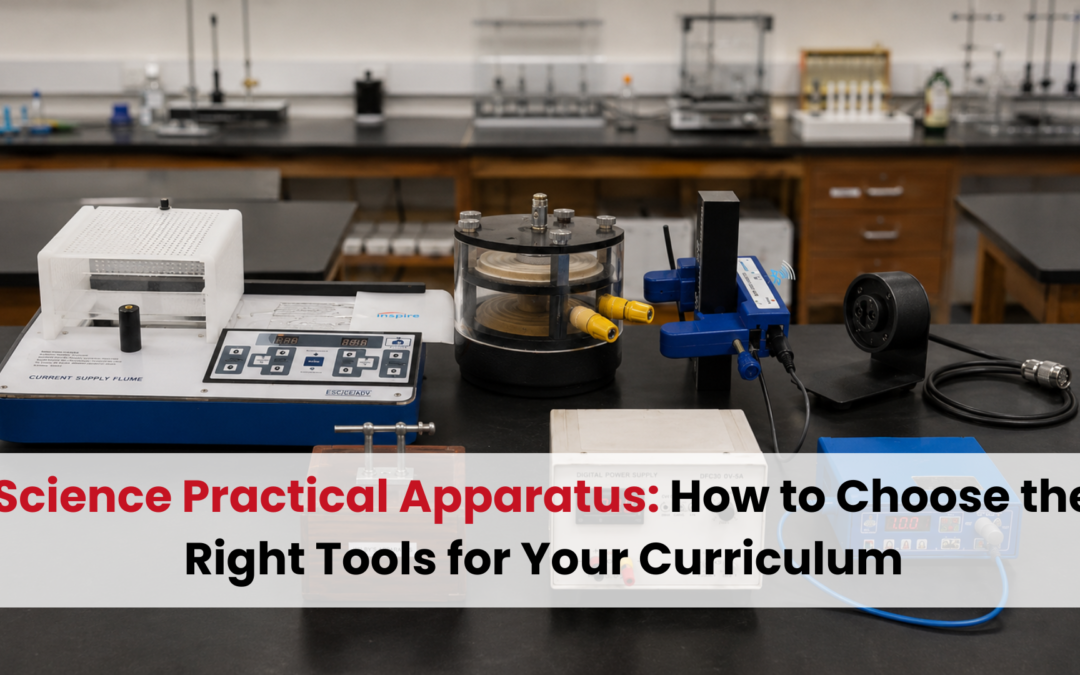
The heart of scientific discovery lies in the laboratory. While textbooks provide the roadmap, it is the hands-on application of theories that truly navigates a student toward mastery. For educational institutions and department heads, selecting the correct Science Practical Apparatus is one of the most critical decisions in curriculum planning. The right tools do more than just facilitate experiments; they bridge the gap between abstract thought and tangible reality.
However, with a vast array of equipment available, from basic glassware to sophisticated digital sensors, making the right choice requires a strategic approach. Here is a comprehensive guide on how to select the ideal apparatus to enrich your science curriculum.
Aligning Equipment with Learning Objectives
The first step in choosing any Science Practical Apparatus is to ensure it aligns directly with your specific curriculum goals. Every piece of equipment in the lab should serve a pedagogical purpose. Before making a purchase, ask: “What specific concept does this tool help demonstrate?”
For a middle school curriculum, the focus might be on foundational observation, requiring robust and simple tools like magnifying glasses, basic thermometers, and spring scales. In contrast, an advanced high school or university-level physics course might require precision instruments such as air tracks, digital timers, or spectrometers to explore Newtonian mechanics and wave theory. By mapping your equipment list to your syllabus, you avoid “cluttering” the lab with gadgets that offer high novelty but low educational value.
Prioritizing Durability and Safety
Educational environments are unique; equipment is handled by hundreds of students with varying degrees of experience. Therefore, durability is non-negotiable. When selecting your Science Practical Apparatus, look for materials that can withstand frequent use. For example, opting for borosilicate glassware ensures resistance to thermal shock, while choosing stainless steel or high-grade polymers for mechanical tools prevents corrosion and wear.
Safety is the twin pillar of durability. Ensure that all electrical components are properly insulated and that any chemicals or heat sources come with clear safety protocols. Tools designed specifically for education often include safety features—such as recessed laser apertures or shatter-resistant casings—that professional industrial tools might lack.
Balancing Traditional vs. Digital Tools
We live in a digital age, and many modern curricula are shifting toward data-logging software and digital sensors. These tools allow students to collect real-time data on temperature, pH, or velocity and graph it instantly. This is invaluable for teaching data analysis and modern research methods.
However, the “old school” Science Practical Apparatus still holds immense value. There is a specific cognitive benefit to a student manually reading a meniscus on a graduated cylinder or balancing a triple-beam balance. These manual skills build “lab sense”—an intuitive understanding of measurement and error. A well-rounded curriculum should offer a hybrid approach: using traditional tools to teach the “how” and digital tools to explore the “why” through larger datasets.
Scalability and Versatility
Budget constraints are a reality for most science departments. To maximize the return on investment, look for versatile apparatus that can be used across multiple grade levels or topics. A high-quality power supply, for instance, can be used for electrolysis in chemistry, electromagnetism in physics, and even staining slides in biology.
Similarly, modular kits are often more cost-effective than single-purpose machines. Components that can be reconfigured for different experiments—such as optics benches that accommodate various lenses and mirrors—ensure that your lab remains adaptable as the curriculum evolves over the years.
Storage and Maintenance Considerations
The longevity of your Science Practical Apparatus depends largely on how it is stored and maintained. Before acquiring new tools, consider the storage capacity of your facility. Do you have the necessary cabinets for chemical storage? Are there padded cases for sensitive optical equipment?
Choosing tools from reputable suppliers like Inspire Physics often means you have access to better documentation and replacement parts. Being able to order a single replacement lens rather than an entirely new kit can save a department thousands of dollars over a decade.
Inspiring Student Curiosity
Ultimately, the goal of a science lab is to inspire. The “wow” factor should not be underestimated. When students walk into a room and see a Van de Graaff generator or a well-organized physics kit, their curiosity is immediately piqued. The apparatus should be inviting and intuitive enough that students feel empowered to explore, rather than intimidated by the complexity.
Conclusion: Investing in the Future
Choosing the right Science Practical Apparatus is an investment in the future scientists, engineers, and doctors sitting in your classroom. By focusing on curriculum alignment, safety, and a balance between classic and modern technology, you create an environment where learning is not just a passive intake of facts, but an active pursuit of truth.
High-quality equipment does not just make teaching easier; it makes learning unforgettable. When a student uses the right tool to witness a law of nature in action, you aren’t just checking off a curriculum requirement—you are opening a door to a lifetime of discovery.
