

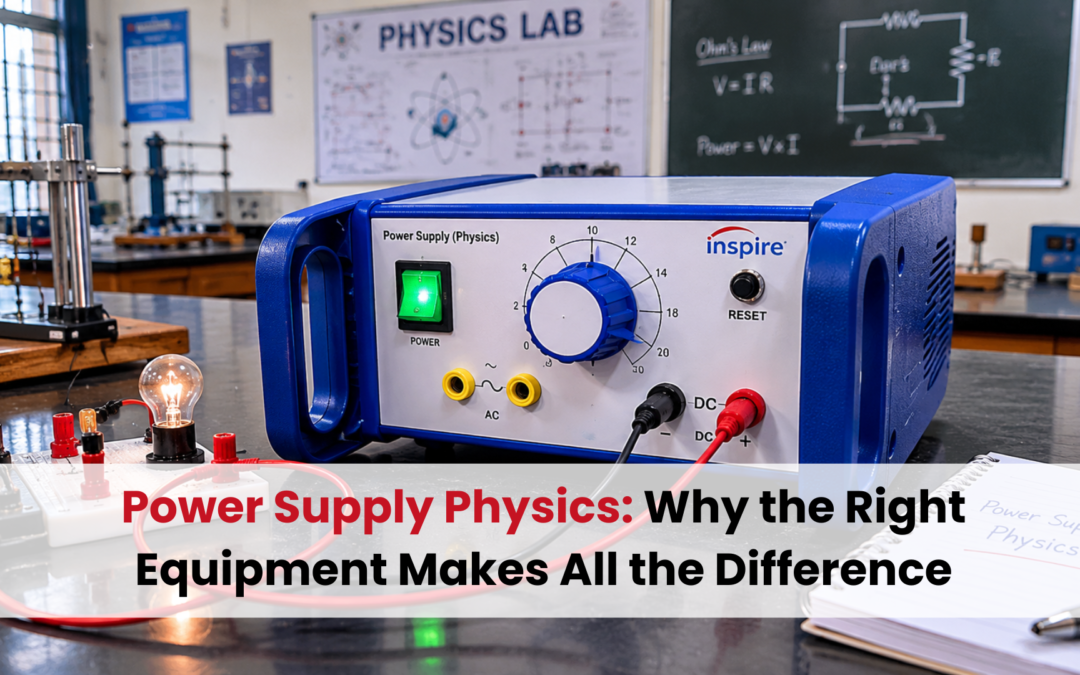
In the realm of scientific inquiry, the pursuit of precision is relentless. Whether you are a student exploring the fundamentals of electromagnetism or a researcher pushing the boundaries of quantum mechanics, the integrity of your results hinges on a factor often overlooked: the stability of your power source. Understanding Power Supply Physics is not merely an academic exercise; it is a practical necessity for anyone serious about experimental accuracy and equipment longevity.
The Foundation of Every Experiment
At its core, a power supply is a device that converts one form of electrical energy into another. However, in a laboratory setting, this definition is far too simplistic. The physics behind a high-quality power supply involves complex regulation, filtration, and transformation processes designed to deliver a “clean” signal.
When we talk about “clean” power, we are referring to a signal that is free from ripple and noise. In an ideal world, a Direct Current (DC) power supply would provide a perfectly flat voltage line. In reality, the rectification process—converting Alternating Current (AC) from a wall outlet into DC—leaves behind small periodic variations known as “ripple.” A superior power supply utilizes advanced capacitors and inductors to smooth these variations, ensuring that the physics of your experiment is influenced only by your variables, not by the fluctuations of your electricity.
Accuracy, Precision, and the Signal-to-Noise Ratio
In physics, the distinction between accuracy and precision is vital. A power supply might be accurate (providing a voltage close to the target) but not precise (failing to provide that exact voltage consistently). High-end laboratory power supplies are engineered with low-drift components that maintain a steady output even as the internal temperature of the unit rises.
For sensitive measurements—such as those involving semiconductors or low-level signal amplification—the signal-to-noise ratio is paramount. Low-quality power supplies often introduce “electronic noise” into the circuit. This noise can mask subtle physical phenomena, leading to incorrect data or the failure to observe a breakthrough. By investing in equipment with high-performance shielding and linear regulation, you ensure that the Power Supply Physics within your lab supports, rather than hinders, your discoveries.
Protection for Your Most Valuable Assets
Beyond data integrity, the right equipment serves as a safeguard. Laboratory instruments are often significant investments. A power supply with poor voltage regulation or inadequate surge protection can inadvertently damage the very equipment it is meant to power.
Quality units incorporate features like Over-Voltage Protection (OVP) and Over-Current Protection (OCP). These are not just safety features; they are applications of circuit theory designed to create a “fail-safe” environment. If a component in your experimental setup fails and begins to draw excessive current, a smart power supply will detect the anomaly and shut down instantly, preventing a domino effect of hardware damage.
Versatility in Modern Pedagogy
For educational institutions, the versatility of power equipment is a major consideration. Modern physics education requires moving between different types of loads—from high-resistance electrostatic experiments to low-resistance electromagnetic coils.
A “constant current” mode is just as important as “constant voltage.” For instance, when studying the magnetic field of a solenoid, the physics dictates that the field strength is proportional to the current. A power supply that can lock in a specific amperage regardless of the coil’s temperature changes is an invaluable tool for demonstrating these laws consistently to a classroom of students.
Sustainability and Efficiency
We cannot discuss modern physics without touching upon efficiency. Switching power supplies (SMPS) have become popular due to their high efficiency and compact size. They work by “switching” the input voltage on and off at very high frequencies, using the duty cycle to regulate the output. While they are more efficient than traditional linear supplies, they can introduce high-frequency noise.
The choice between a linear and a switching power supply often comes down to the specific physics of your application. For high-power applications where heat dissipation is a concern, a switching supply is ideal. For low-noise, high-precision laboratory work, a linear supply remains the gold standard.
Conclusion: Choosing the Right Path
The equipment you choose is an extension of your methodology. In the world of Power Supply Physics, there is no one-size-fits-all solution, but there is a clear distinction between “adequate” and “excellent.”
Whether you are building a dedicated research facility or equipping a high school lab, prioritizing the quality of your power sources is a commitment to the scientific method itself. It reduces the “unknowns” in your equations and provides a stable platform for exploration. When your power is consistent, your results are reliable, and your focus can remain where it belongs: on the wonders of the physical world.
For those looking to explore the intersection of theory and practical application, resources like Inspire Physics provide the insights needed to navigate the complex landscape of laboratory instrumentation and scientific education. Invest in the right equipment today, and empower the discoveries of tomorrow.
