
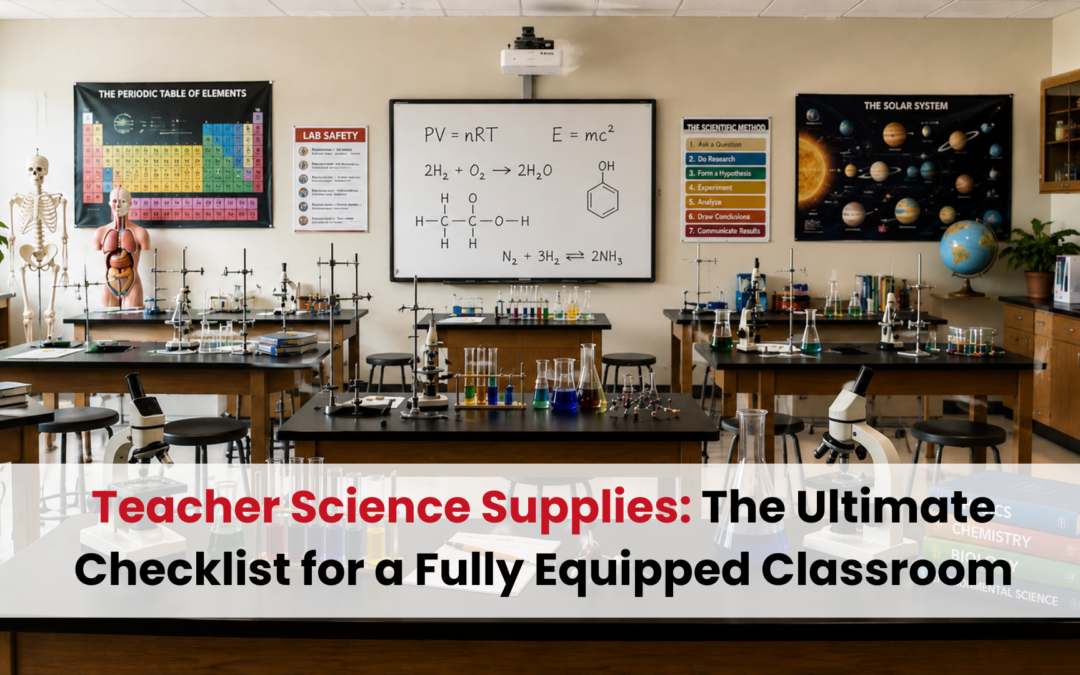
For any educator, the classroom is more than just a room with desks and a whiteboard; it is a launchpad for curiosity. In the realm of science, this is especially true. A well-stocked laboratory or classroom allows students to move beyond the textbook and engage with the physical laws that govern our universe. However, building a laboratory from scratch or auditing an existing one can be a daunting task.
Having the right Teacher Science Supplies on hand ensures that lessons flow smoothly and that “teachable moments” aren’t lost to missing components or faulty equipment. Whether you are teaching GCSE, A-Level, or introductory physics, this ultimate checklist will help you ensure your classroom is fully equipped for discovery.
1. The Core Essentials: Power and Measurement
Before diving into specific experiments, every science classroom requires a foundation of reliable power and precision measurement tools. Without these, even the most exciting demonstration can fail to produce accurate data.
- Robust Power Supplies: High-quality power supplies are the heartbeat of the physics lab. Look for units that offer both AC and DC outputs, such as the 2-14V range, to accommodate everything from simple circuits to more complex electromagnetic setups.
- Precision Meters: Digital ammeters and voltmeters are essential for quantitative analysis. Unlike older analog models, modern digital meters provide clear, instant readings that help students minimize parallax errors and focus on the relationship between variables.
- Timing Equipment: In mechanics, timing is everything. While traditional stopwatches have their place, “intelligent” light gates and wireless timing balls allow for much higher precision when measuring the acceleration of freefall or the velocity of a dynamics car.
2. Mechanics: Exploring Motion and Force
Mechanics is often the first major topic students encounter. To make Newton’s Laws feel real, students need to see them in action without the interference of excessive friction.
- Dynamics Track Systems: A smooth, low-friction track is vital. Wireless dynamics cars have revolutionized this area, allowing data to be sent directly to a computer or tablet in real-time.
- Air Tracks: For nearly frictionless motion experiments, a linear air track remains a gold standard in Teacher Science Supplies. It is perfect for demonstrating elastic and inelastic collisions.
- Force Measurement: A set of reliable Newton meters (spring balances) in various ranges (0-10N, 0-50N) is necessary for hands-on exploration of hooks law and resultant forces.
3. Light and Optics: Visualizing the Invisible
Optics is a highly visual subject that can be incredibly engaging if the equipment is right.
- Laser Ray Kits: Modern laser ray kits allow teachers to demonstrate reflection, refraction, and total internal reflection with high-visibility beams that work even in partially lit rooms.
- Colour Mixers: To explain the physics of light and the primary colors of the spectrum, an LED-based color mixer is a compact and effective tool for any science department.
- Lenses and Prisms: A comprehensive set of concave and convex lenses, along with glass or acrylic prisms, allows students to map out focal points and understand how the human eye or a camera lens functions.
4. Waves and Oscillations: From Sound to Signal
Understanding waves is crucial for both classical physics and modern telecommunications.
- Ripple Tanks: A compact, advanced ripple tank is perhaps the most effective way to show wave phenomena like diffraction and interference. Seeing physical ripples on water helps students conceptualize abstract wave properties.
- Signal Generators: An advanced signal generator is a versatile piece of Teacher Science Supplies. When paired with a vibration generator or a loudspeaker, it allows students to visualize standing waves and explore frequency response.
5. Electricity and Magnetism: Harnessing Energy
Electricity can be an abstract concept for many students. Hands-on kits help bridge the gap between circuit diagrams and reality.
- Van de Graaff Generators: Nothing captures a student’s attention quite like static electricity. A reliable Van de Graaff generator is a staple for demonstrating electric fields and charge.
- Electromagnetism Kits: To teach the relationship between electricity and magnetism, teachers need demountable transformers and magnetic flux density meters. These tools allow students to see how transformers work and how motors are powered.
6. Safety and Storage
No checklist is complete without mentioning the “boring but essential” side of a science lab.
- Safety Gear: Ensure you have high-quality safety goggles, heat-resistant mats, and organized storage for any radioactive sources (such as Geiger-Muller tube holders).
- Modular Storage: Science supplies consist of many small parts. Using modular bins and labeled trays ensures that your equipment lasts longer and is easy to find during a busy lesson.
Conclusion: Inspiring the Next Generation
A fully equipped classroom does more than just make a teacher’s life easier; it creates an environment where students feel like real scientists. By investing in high-quality, durable Teacher Science Supplies, schools can ensure that the next generation of engineers, physicists, and researchers has the tools they need to succeed.
When selecting equipment for your classroom, prioritize items that meet modern safety standards (like CE certification) and look for technology that integrates with digital learning, such as wireless sensors. With the right checklist in hand, you can transform your science lab into a true center of innovation.
For more information on high-quality equipment and to explore a comprehensive range of professional-grade classroom tools, visit https://inspirephysics.com/.