
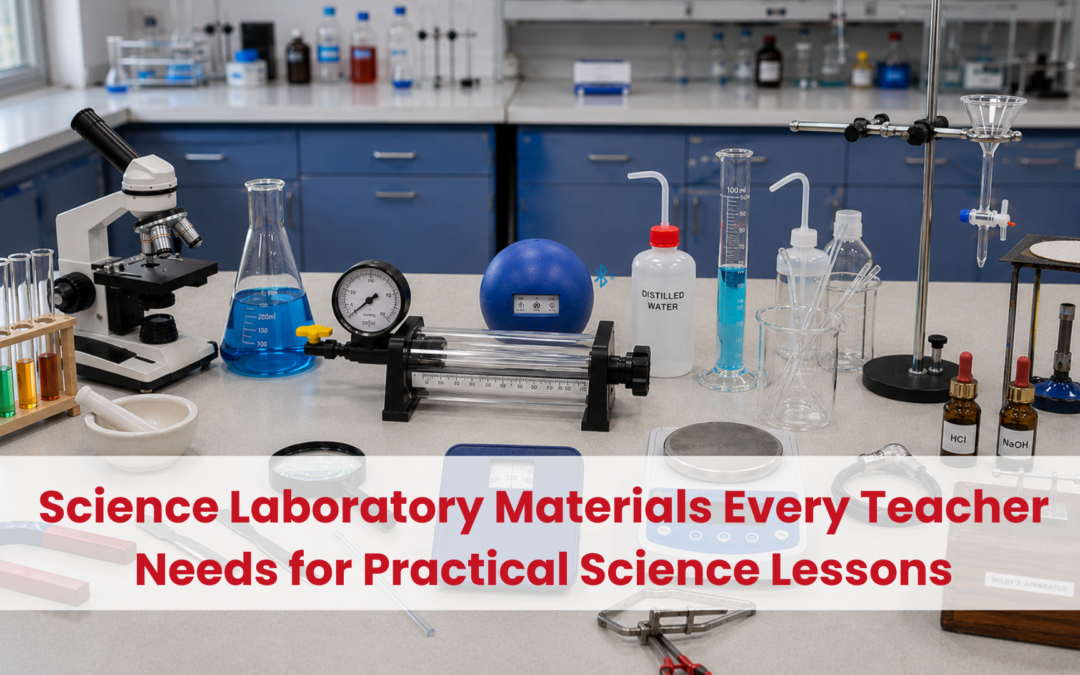
The heart of a great science education lies in the “aha!” moment—that split second when a student sees a theoretical concept manifest in the physical world. Whether it is the sudden change of a chemical indicator or the perfect convergence of light through a lens, practical lessons are what transform science from a set of memorized facts into a lifelong passion. However, the success of these lessons depends entirely on the availability and quality of the tools at hand.
Curating a list of essential Science Laboratory Materials is a foundational task for any educator or department head. A well-stocked lab ensures that the momentum of a lesson is never lost to missing equipment or broken apparatus. Below is a comprehensive guide to the must-have materials that every teacher needs to deliver high-impact, practical science lessons.
The Foundation: Safety and Maintenance
Before any experiment begins, safety must be the priority. A lab that lacks proper safety gear is not a functional lab.
- Personal Protective Equipment (PPE): This includes high-quality safety goggles that fit over prescription glasses, heat-resistant gloves, and lab aprons.
- Containment and Cleanup: Every teacher should have easy access to spill kits, eyewash stations, and fire blankets.
- Storage Solutions: Organization is key. Having labeled, chemical-resistant bins for Science Laboratory Materials ensures that delicate instruments remain calibrated and dangerous substances are properly secured.
Essential Glassware and Plasticware
While digital sensors are becoming more common, the “bread and butter” of any lab remains the vessels used to hold, mix, and measure substances.
- Beakers and Flasks: A range of sizes (50ml to 1000ml) is necessary. Erlenmeyer flasks are particularly important for titrations or any experiment requiring swirling without splashing.
- Graduated Cylinders: For precise volume measurements, plastic graduated cylinders are often preferred in school settings due to their durability and resistance to breaking.
- Test Tubes and Racks: Essential for small-scale reactions and qualitative analysis.
Measurement and Precision Tools
In science, if you aren’t measuring, you’re just playing. To teach the scientific method properly, students must have access to reliable measurement tools.
- Digital Scales: High-precision electronic balances are vital for chemistry experiments involving stoichiometry.
- Thermometers: Digital probes are excellent for data logging, but traditional alcohol-based thermometers are still valuable for teaching students how to read manual scales.
- Stopwatches: Whether used for timing a chemical reaction or measuring the period of a pendulum in physics, timing is a critical variable.
Physics-Specific Apparatus
Physics lessons often require specialized Science Laboratory Materials that can withstand repeated use by energetic students.
- Optics Kits: These should include ray boxes, lenses (convex and concave), and prisms. These tools are indispensable for teaching the behavior of light.
- Electricity Components: A reliable stock of breadboards, jumper wires, resistors, LEDs, and multimeters allows students to build and troubleshoot circuits safely.
- Dynamics Carts and Tracks: For teaching Newton’s Laws of Motion, having low-friction tracks and carts is essential for gathering clean, accurate data.
The Chemistry Corner: Consumables and Reagents
A chemistry lab is only as good as its stock of consumables. Teachers need a reliable supply of:
- Indicators: Litmus paper, pH strips, and universal indicator solutions for acid-base lessons.
- Filter Paper and Funnels: For teaching separation techniques like filtration.
- Common Reagents: Copper sulfate, magnesium ribbon, and dilute acids/bases are the “workhorses” of middle and high school chemistry.
Why Quality Materials Matter
The quality of Science Laboratory Materials directly impacts student outcomes. When equipment is faulty—such as a scale that won’t tare or a lens that is too scratched to focus light—students become frustrated. They may begin to doubt the scientific laws they are testing simply because the hardware failed. By investing in high-quality, durable materials, schools provide a “clean” data environment where the laws of nature can shine through without the interference of equipment error.
Furthermore, having a complete set of materials allows for inquiry-based learning. Instead of a teacher performing a demonstration at the front of the room, students can work in small groups, developing their fine motor skills and learning how to troubleshoot real-world problems.
Conclusion
Building a world-class school laboratory is a marathon, not a sprint. It starts with the basics—safety, glassware, and measurement—and expands into specialized kits for physics and chemistry. By ensuring these Science Laboratory Materials are always in stock and well-maintained, teachers can move away from “teaching to the test” and move toward “teaching for discovery.”
For educators looking to source the best equipment and find inspiration for their next practical lesson, Inspire Physics offers a wealth of information and professional-grade tools designed specifically for the classroom environment.