

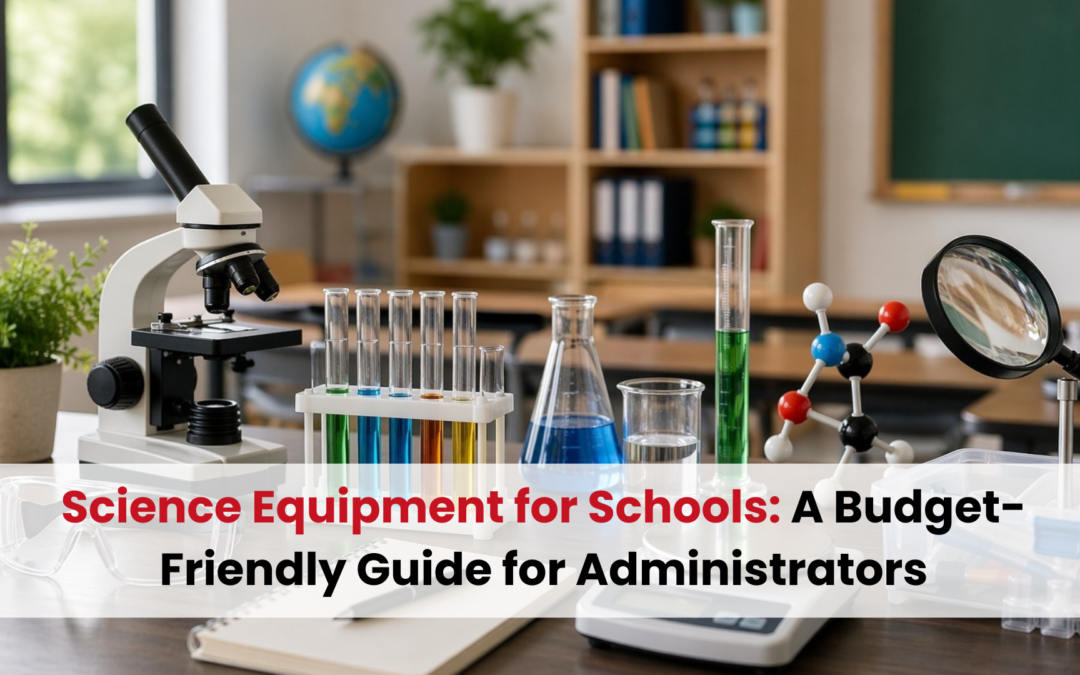
Equipping a school laboratory is a task that carries significant weight. For administrators, it is a delicate balancing act between fiscal responsibility and the moral imperative to provide students with a high-quality, hands-on education. The right science equipment for schools does more than occupy space on a lab bench; it serves as a gateway to curiosity, allowing students to move beyond the abstract equations of a textbook and into the tangible world of discovery.
At Inspire Physics, we believe that financial constraints should never be a barrier to scientific exploration. Creating a robust, engaging laboratory environment is entirely possible with a strategic approach to procurement and maintenance.
The Pedagogical Value of Hands-On Learning
Before diving into the logistics of budgeting, it is helpful to center ourselves on the “why.” Science is not a static body of knowledge to be memorized; it is a process of inquiry. When a student adjusts the weights on a pulley system or observes the refraction of light through a prism, they are developing critical thinking skills that extend far beyond the classroom.
Providing reliable science equipment for schools ensures that these moments of “eureka” are frequent and accessible. A well-equipped lab fosters a sense of wonder and prepares students for a world where scientific literacy is increasingly vital.
Strategic Planning: Needs vs. Wants
The first step in a budget-friendly equipment strategy is a thorough needs assessment. It is easy to be swayed by high-tech gadgets that look impressive during parent tours but offer limited curriculum utility.
- Consult the Educators: Your science department heads are your best resource. Ask them to categorize equipment into “Essential,” “Supportive,” and “Aspirational.” Focus your initial budget on the essentials—the items that are used across multiple grade levels and modules.
- Versatility is Key: Prioritize multi-purpose tools. For example, high-quality digital sensors can often be used in physics, chemistry, and biology experiments. Investing in versatile science equipment for schools maximizes the “per-use” value of every dollar spent.
- Inventory Audit: Before purchasing new items, conduct a rigorous audit of existing stock. Often, valuable equipment is tucked away in storage, requiring only minor repairs or a fresh set of batteries to become functional again.
Sustainable Procurement Strategies
Once you have a clear list of requirements, the next challenge is sourcing. Smart procurement is about looking beyond the sticker price and considering the total cost of ownership.
Prioritizing Durability
In a school setting, equipment must withstand heavy use. It is often more cost-effective to buy a slightly more expensive, high-quality microscope that will last ten years than a cheap plastic version that will break within one semester. At Inspire Physics, we emphasize that quality is a long-term savings strategy.
The Power of Bulk and Timing
If your school is part of a larger district or network, consider collaborative purchasing. Bulk orders often unlock significant discounts from suppliers. Additionally, many scientific supply companies run promotions during the “off-season” (late autumn or early spring) to clear inventory before the summer rush.
Maintenance: The Secret to Budget Longevity
The most effective way to save money on science equipment for schools is to ensure the equipment you already own stays in peak condition. A culture of care should be fostered among both faculty and students.
- Calibration Schedules: Regularly calibrate measuring instruments like balances and pH meters. This prevents the frustration of inaccurate data and extends the life of the sensors.
- Storage Solutions: Proper storage is often overlooked. Chemical reagents should be stored according to safety protocols, and delicate optical equipment like lenses and mirrors should be kept in dust-free, climate-controlled environments.
- Simple Repairs: Empower your lab technicians or facility staff to perform basic troubleshooting. Replacing a blown fuse or tightening a loose screw on a tripod can save an entire unit from being discarded.
Leveraging Open-Source and Digital Alternatives
While there is no true substitute for the tactile experience of a physical lab, digital tools can supplement a budget-friendly science program.
- Virtual Simulations: For experiments that are too costly, dangerous, or time-consuming to perform in person, virtual labs (such as those offered by PhET or similar platforms) can provide a theoretical bridge.
- Low-Cost Innovations: Encourage teachers to look into “frugal science.” Many fundamental principles can be demonstrated using everyday materials—cardboard, magnets, and household liquids—allowing you to save the formal budget for specialized items that cannot be improvised.
Creating an Environment of Discovery
As an administrator, your role is to provide the infrastructure where teaching and learning can flourish. By focusing on essential, durable, and versatile science equipment for schools, you are building a foundation for future engineers, doctors, and researchers.
At Inspire Physics, we are committed to supporting educational leaders in this mission. We understand that every school has a unique set of challenges, but with a calm, methodical approach to budgeting and a focus on long-term value, you can create a laboratory that inspires the next generation.
Science is a journey. With the right tools in hand, your students are ready to take the first step.
