

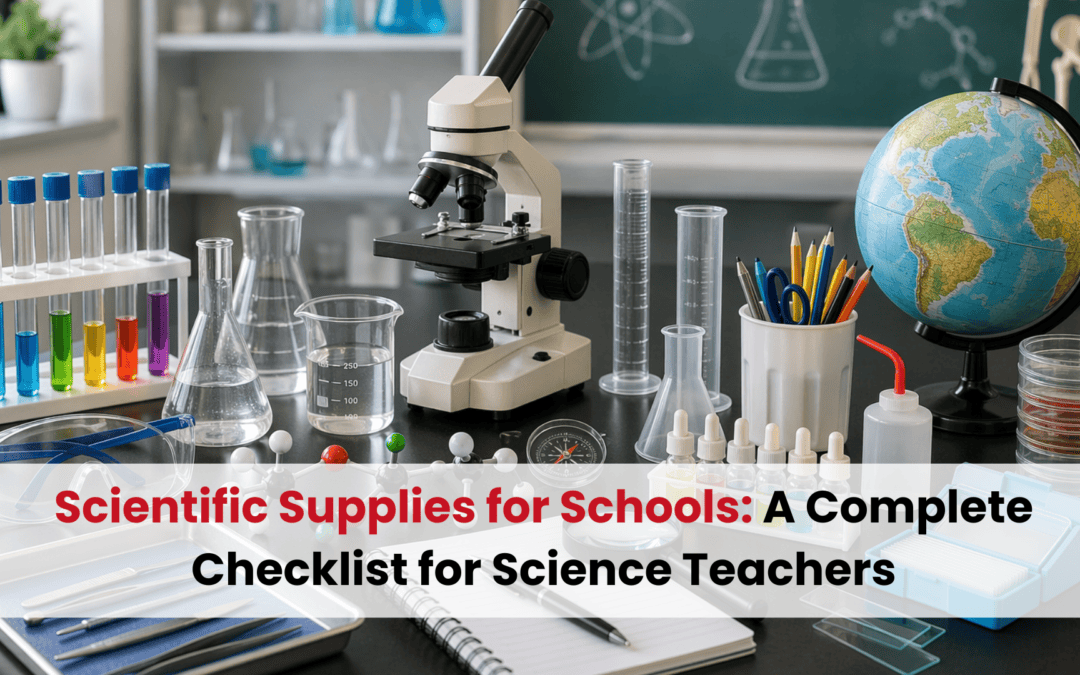
The magic of science doesn’t just happen in the pages of a textbook; it happens at the moment a student sees a chemical reaction change colors, watches a pendulum swing in perfect rhythm, or peers through a lens to see a world invisible to the naked eye. For science teachers, the laboratory is a sanctuary of discovery. However, keeping that sanctuary running smoothly requires a meticulous approach to organization and procurement.
Building a comprehensive inventory of Scientific Supplies for Schools is about more than just filling cupboards. It is about creating an environment where curiosity is never sidelined by a missing beaker or a dead battery. At Inspire Physics, we understand that the right tools are the bridge between a complex theory and a “eureka” moment.
In this guide, we’ll walk through the essential checklist every science department needs to foster a safe, engaging, and highly functional learning environment.
1. The Foundation: Essential Glassware and Plasticware
Every experiment starts with a container. While digital simulations are useful, nothing replaces the tactile experience of measuring and mixing. A well-stocked lab should have a variety of sizes to accommodate different group scales.
- Beakers and Flasks: High-quality borosilicate glass (like Pyrex or Kimax) is essential for heat resistance. Ensure you have a range from 50ml to 1000ml.
- Graduated Cylinders: Accuracy is the heart of science. Stock both glass and durable plastic versions for different age groups.
- Test Tubes and Racks: These are the workhorses of the chemistry lab. Don’t forget the brushes—cleaning is as much a part of the scientific process as the experiment itself.
- Pipettes and Droppers: For precise liquid handling, disposable plastic pipettes are convenient, while glass Mohr pipettes are better for advanced quantitative work.
2. Measurement and Precision Tools
To teach the laws of physics and the constants of chemistry, students must be able to quantify their observations. Precision tools are the backbone of any Scientific Supplies for Schools collection.
- Digital Scales and Triple Beam Balances: While digital scales are fast, triple beam balances are excellent for teaching students the fundamentals of mass and measurement.
- Thermometers: Move toward digital or alcohol-based thermometers to maintain a mercury-free, safe environment.
- Stopwatches: Essential for physics experiments involving velocity, acceleration, and rates of reaction.
- Caliper and Metric Rulers: Teaching the importance of “significant figures” starts with high-quality measuring sticks and calipers.
3. Physics Specific Gear: Bringing Forces to Life
Physics is often the most demanding subject when it comes to specialized equipment. To make abstract concepts like electromagnetism or mechanics tangible, you need reliable kits.
- Optics Kits: Lenses, mirrors, prisms, and laser pointers help students visualize how light behaves.
- Electricity and Magnetism: Breadboards, connecting wires, resistors, and various magnets (bar, horseshoe, and neodymium) allow students to build their own circuits.
- Force and Motion: Friction blocks, pulleys, spring scales, and dynamic carts are must-haves for Newtonian physics lessons.
4. The Biological Frontier
Biology labs require a mix of the microscopic and the anatomical.
- Microscopes: A few high-quality compound microscopes are better than a dozen poor ones. Supplement these with digital microscope cameras so you can project slides for the whole class to see.
- Prepared and Blank Slides: Having a library of prepared slides (plant cells, animal tissues, bacteria) provides instant engagement, while blank slides encourage students to find their own specimens.
- Anatomical Models: Human torso models or skeletal replicas provide a 3D understanding that 2D diagrams simply cannot match.
5. Safety First: The Non-Negotiables
A science teacher’s primary responsibility is the safety of their students. Your checklist for Scientific Supplies for Schools is incomplete without a robust safety audit.
- Personal Protective Equipment (PPE): This includes splash-proof goggles (which should be sanitized after every use), lab aprons, and nitrile gloves.
- Chemical Storage: Ensure you have a dedicated, locked flammables cabinet and acid cabinet.
- Emergency Gear: Check that your eyewash stations, safety showers, and fire extinguishers are inspected annually and are easily accessible.
6. Consumables and “The Little Things”
It’s often the smallest items that stall an experiment. Keep a “running list” of consumables that need frequent replenishing:
- pH paper and Litmus strips
- Filter paper
- Distilled water
- Batteries (AA, AAA, and 9V)
- Standard chemicals (baking soda, vinegar, iodine, copper sulfate)
Creating a Culture of Curiosity at Inspire Physics
At Inspire Physics, we believe that science is a living, breathing discipline. When a school is equipped with the right Scientific Supplies for Schools, the teacher is freed from the stress of “making do” and can focus on what they do best: inspiring the next generation of thinkers.
Organizing a lab can feel like an overwhelming task, but remember that you don’t have to stock everything at once. Start with the essentials—safety and measurement—and build your inventory as your curriculum evolves.
Science is a journey of trial and error. By providing students with professional-grade tools, you aren’t just teaching them facts; you are teaching them that their inquiries are important and that the world is a place waiting to be understood.
Is your lab ready for the next semester? Use this checklist to audit your supplies and ensure that when the next big question arises, you have exactly what you need to find the answer. For more resources on making physics and general science accessible and exciting, stay tuned to Inspire Physics.
